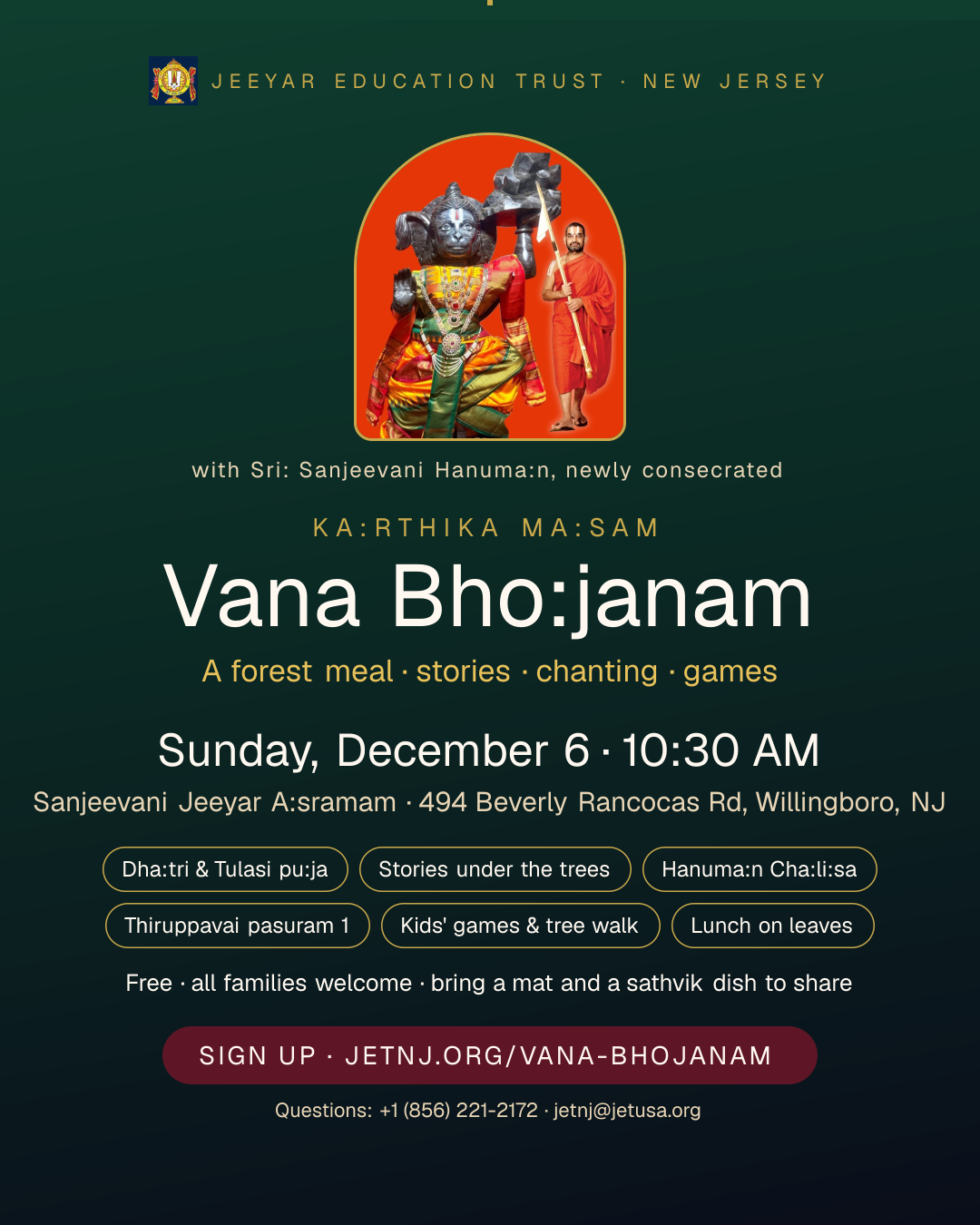
Vana Bho:janam is not a picnic with a prayer attached. It is one of the oldest forms of worship in our tradition, and every layer of the tradition has a story about it. These are the ones told under the trees on December 6.
Veda · Rig Veda 10.146 (Aranya:ni Su:kta)
Aranya:ni, the spirit of the forest
One of the Rig Veda's gentlest hymns is sung to Aranya:ni, the forest herself. The seer calls her the mother of wild things, who never harms unless one attacks her, who is full of food without tilling, fragrant with balm, and who sends the traveller home at dusk with the sounds of cowbells and crickets. The Veda does not see the forest as wilderness to be feared but as a generous presence to be greeted. The later A:ranyakas, the 'forest books' of each Veda, were taught there by teachers who had withdrawn from the village to think.
For the children: “The forest is a mother who feeds without being asked.”
Veda · Taittiri:ya Upanishad, Bhrigu Valli 3.1–3.10
Annam Bramha: food is the Supreme
Bhrigu asks his father Varuna to teach him Bramhan. Varuna says: go and do tapas. Bhrigu's first realisation is 'annam Bramha', food is Bramhan, for all beings are born from food, live by food and return to food. The Upanishad adds three vows: do not speak ill of food, do not waste food, and grow food in abundance, for the one who gives food receives in the same measure. When the a:sramam serves a go:shti lunch under the trees, that is the Upanishad being lived, not merely read.
For the children: “Serve food with respect; never waste it; share it in plenty.”
Pura:na · Skanda Pura:na, Ka:rthika Ma:ha:thmya; Padma Pura:na
Da:mo:dara in the a:mla tree
The Ka:rthika Ma:ha:thmya says that in this month Sri: Maha: Vishnu as Da:mo:dara, with Lakshmi, dwells in the Dha:tri tree, the a:mla or usiri. To bathe with its leaves, to light a lamp beneath it, to worship it and then to eat beneath its shade is called Dha:tri Bho:janam or Vana Bho:janam, and the Pura:na promises it washes away the sins of a year. This is why Telugu and Tamil families have, for centuries, packed food and gone out to the groves in Ka:rthika. The tradition is not a picnic that borrowed a prayer; it is a prayer that includes a meal.
For the children: “A meal under the a:mla tree in Ka:rthika is a meal in the Lord's presence.”
Pura:na · Sri:mad Bha:gavatam 10.13
Krishna's lunch on the Yamuna bank
Krishna takes the calves and the cowherd boys to the forest and calls a lunch break on the sandy bank of the Yamuna. The Bha:gavatam paints it exactly: Krishna sits in the middle like the centre of a lotus, the boys around him like petals, each one turning his face to Krishna so that Krishna is eating with him; some use flowers as plates, some bark, some their own hands; they joke, they steal from each other's packets, and Krishna, with the flute tucked in his waistband, laughs with a lump of rice in his hand. Bramha himself comes to watch and is bewildered. The Lord of the universe chose a forest meal with friends as the happiest hour of his day.
For the children: “God is happiest eating with friends under the trees.”
Ithiha:sa · Va:lmi:ki Ra:ma:yana, Aranya Ka:nda 74
Sabari's berries
Deep in the Dandaka forest an old tribal woman, Sabari, has waited for years because her guru Matanga told her Ra:ma would come. When Ra:ma and Lakshmana arrive she washes their feet and offers what the forest gave her: fruit and berries she has gathered. Tradition tells that she tasted each one so that only the sweet ones would reach Ra:ma. Ra:ma eats with joy. Not the palace of Ayodhya, not the feast of a king: the Ra:ma:yana's most remembered meal is wild fruit in a forest, offered by a woman with nothing, accepted because it was offered with everything.
For the children: “What you offer with love in the forest, the Lord eats with joy.”
Ithiha:sa · Va:lmi:ki Ra:ma:yana, Ayodhya Ka:nda 94–99
Chitraku:ta: the forest as home
Exiled to the forest, Ra:ma does not grieve. On the hill of Chitraku:ta he shows Si:ta: the waterfalls, the flowering trees, the deer and the birds, and tells her that living here with her and Lakshmana he misses nothing of the kingdom. When Bharata comes with the whole city to beg him to return, the family's reunion, its tears and its decisions all happen under the trees. Hanuma:n's own first meeting with Ra:ma is in a forest too, on the slopes of Rishyamu:ka. The forest is where Ra:ma's story is decided.
For the children: “Rama found home, family and friends in the forest.”
Sri: Vaishnava · A:nda:l, Thiruppavai, pasuram 28
'We follow the cows into the forest and eat there'
In the twenty-eighth pasuram of Thiruppavai A:nda:l speaks for the cowherd girls: 'karavaigal pin senru ka:nam se:rndu unbo:m': we follow the cows into the forest and eat there; we are a simple people with no learning, and yet the merit of your taking birth among us is ours. The forest meal is the picture she chooses to describe who the gopis are, and she tells Go:vinda that the bond between them cannot be undone. Every family that sits down at a Vana Bho:janam is sitting inside this pasuram.
For the children: “A:nda:l's gopis ate in the forest, and Krishna was one of them.”
Sri: Vaishnava · A:nda:l, Na:chiya:r Thirumozhi 9; Guruparampara: Prabha:vam
A hundred pots of sweet rice for Azhagar of the forest hill
Thiruma:liruncho:lai, 'the sacred grove hill' near Madurai, is a Divya De:sam whose Lord is simply called Azhagar, the beautiful one of the forest. A:nda:l vowed that she would offer him a hundred pots of akka:ravadisal, sweet milk-rice, and a hundred pots of butter. She merged with Ranganatha before she could keep the vow. Centuries later Bhagavad Ra:ma:nuja climbed the hill and had the two hundred pots prepared and offered in her name. A:nda:l's image at Srivilliputhur is said to have greeted him as her elder brother, and he is still honoured there as 'Ko:il Annan'. A promise of food to the Lord of the forest, kept across centuries by an A:cha:rya: that is how seriously this tradition takes a forest meal.
For the children: “Ra:ma:nuja kept A:nda:l's promise of sweet rice to the Lord of the forest hill.”
Sri: Vaishnava · Guruparampara: Prabha:vam; Thiruva:ymozhi
Nammazhva:r under the tamarind tree
Nammazhva:r, the greatest of the Azhva:rs, spent his first sixteen years in silence and meditation seated in the hollow of a tamarind tree at Azhva:r Thirunagari. That tree, the Thiruppuliya:zhva:r, is still worshipped. Madhurakavi Azhva:r found him there by following a light in the sky, asked him a riddle, received an answer and became his disciple. The thousand verses of Thiruva:ymozhi, which the Sri: Vaishnava tradition reveres as the Tamil Veda, came out of a man who sat under a tree. The tradition has never doubted what quiet time under a tree can produce.
For the children: “The Tamil Veda was born under a tree.”
Sri: Vaishnava · JET Vana Bho:janam tradition
HH Swa:mi:ji and the forest meal
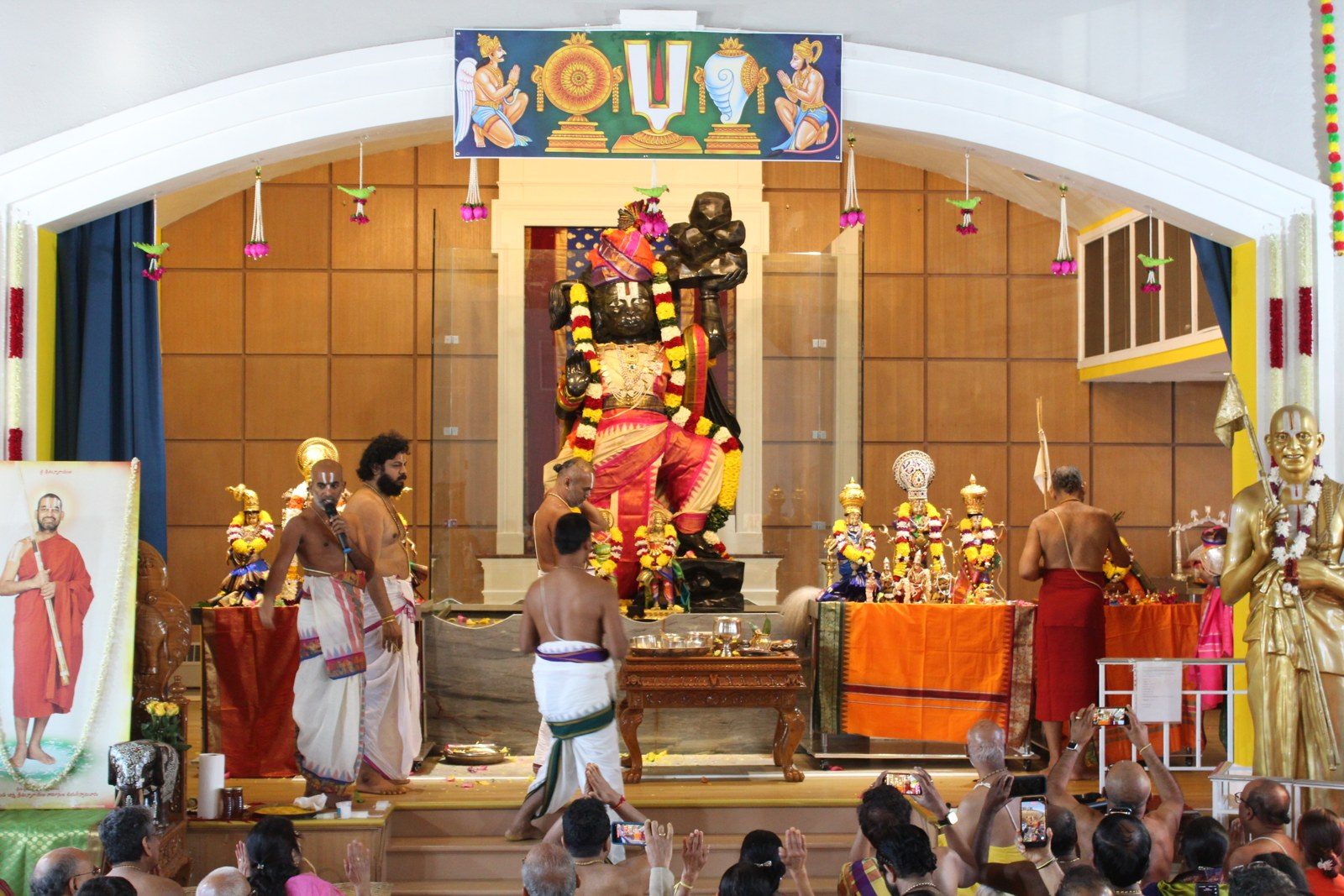
HH Sri: Tridandi Chinna Jeeyar Swa:mi:ji has for decades taken the JET family out of its halls and into groves for Vana Bho:janam: a morning of pu:ja, chanting, Swa:mi:ji's discourse, games for the children and a go:shti meal. Swa:mi:ji's teaching is simple: the Lord did not make a world of walls, and a family that has sat on the earth together, served each other and laughed together, stays together. This December the a:sramam holds its first Vana Bho:janam with Sri: Sanjeevani Hanuma:n consecrated on its own grounds.
For the children: “A family that eats together on the earth stays together.”