The Inspirer · 1909 – 1979
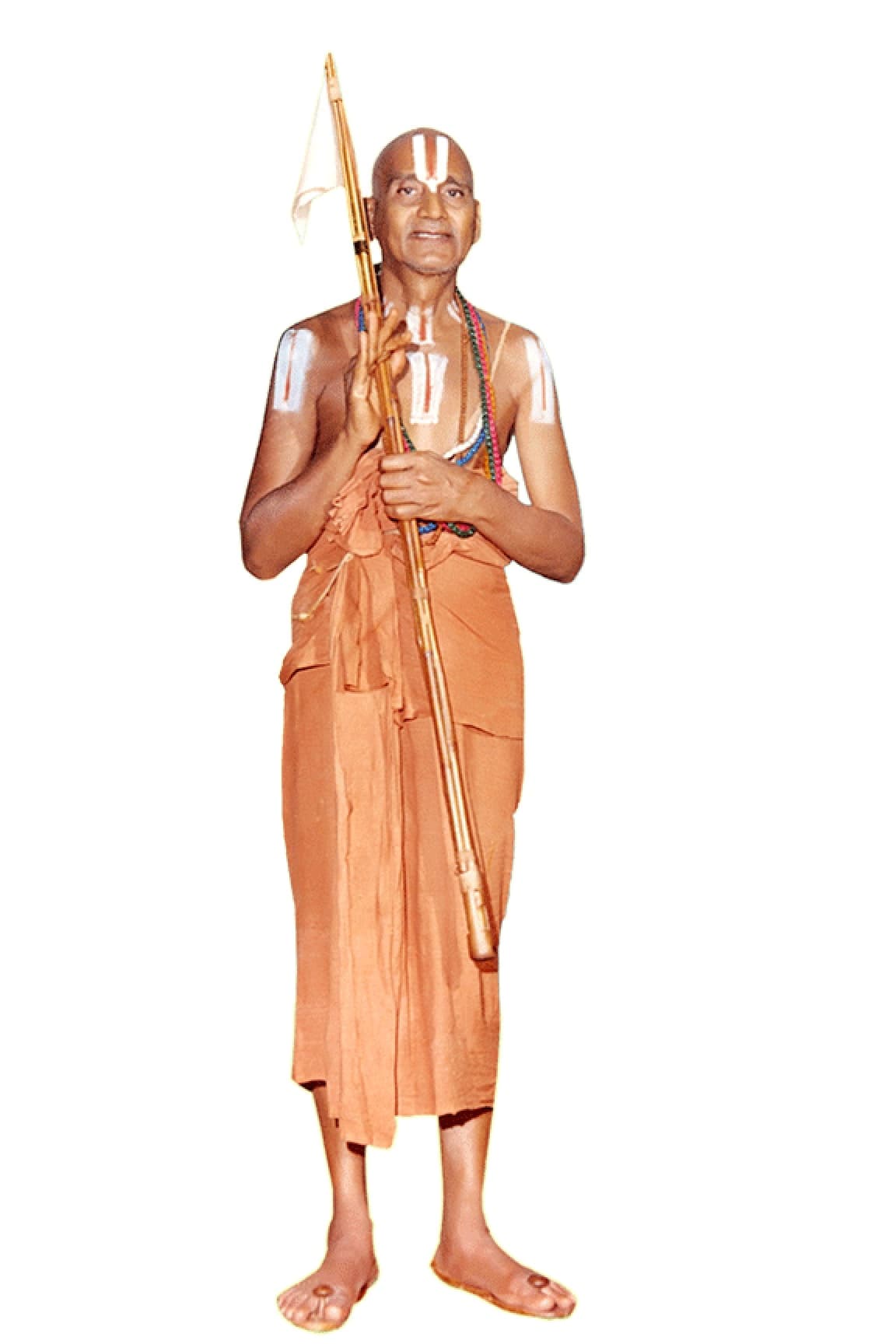
HH Sri Pedda Jeeyar Swamiji
Sri Sri Sri Tridandi Sri:mannarayana Ra:ma:nuja Jeeyar Swa:mi:ji
“Born in this world to revive Ra:ma:nuja's vision — universal brotherhood and universal well-being.”
108
Sri: Ra:ma Kratuvus across India & Nepal
124
Harijan homes built in 1938
10 crore
Ashtakshari chantings at Badarina:th
1947
Bhakthi Nive:dana founded — still monthly
Sacred Record
The Life in Brief
Avatharam
September 1, 1909 · Kakinada, East Godavari — Saumya samvatsara, Sra:vana ma:sa, Uttara:bha:dra nakshathram
Pu:rva:srama name
Sri Thiruvengalacharyulu, of the Vangipuram family
Parents
Sriman Vangipuram Mangayacharya & Srimathi Chudamba
Raised by
Sriman Krishnamacharya & Srimathi Lakshmi Narasamma
Sanya:sa Swi:ka:ram
1954 · Thothadri (Vanamamalai) Mutt, Nanguneri, Tamil Nadu
Parama:padam
December 31, 1979 — Vaikuntha Dwa:dasi · Brindavanam at Nadigaddapalem, Guntur district
Successor
HH Sri Tridandi Sri:mannarayana Ra:ma:nuja Chinna Jeeyar Swa:mi:ji
Philosophy
Visishta:dwaitha of Bhagavad Ra:ma:nuja — universal brotherhood and universal well-being
Equality in Action
Four Pillars of Reform
Long before equality entered the statute books, he practiced the radical compassion of Bhagavad Ra:ma:nuja — with land, labor and fearless public witness.
1920s
Gandhian Freedom Fighter
Answering Gandhiji's call in 1920, he took a lifelong vow of hand-spun khadi that he kept until sanya:sa — and through four decades at Rajahmundry, where he raised the Sri Ranganatha Swamy temple on the Gautami Ghat, he sheltered, fed and steadied those who fought for India's independence.
1938
India's First Harijan Colony
Decades before welfare housing existed, he surrendered his own ancestral lands and built 124 solid homes for the downtrodden — India's first Harijan colony at Arthamuru, with a second at Dwarampudi. He opened worship, Pancha Samska:ram and mantra initiation to every human being, irrespective of birth.
Ongoing
Spiritual Services Inside the Prisons
Convinced that divinity resides in every person, he held discourses for long-term inmates inside central jails — and raised Sri: Ra:ma Stupas within the prison compounds of Rajahmundry, Berhampur and Madurai, leaving the incarcerated a permanent sanctuary for prayer and reform.
Madras
Fearless Defense of Dharma
When anti-Ve:dic agitation closed the public halls of Madras to him, he gathered hundreds of scholars and led an unbroken 27-day Sri: Ra:ma:yana pa:ra:yana and Sri: Ra:ma Pattabhishe:kam on the open platforms of the Chennai railway station — and the hostility dissolved before the chanting did.
Ashtakshari Ko:ti Ha:van · Badarina:th
After three years of cave penance in the freezing Himalayas, he led more than three hundred ritwiks on foot up sixty miles of mountain trail — and the Ashtakshari mantra rose ten crore times with one sacred fire.
The Ashtakshari Kshe:thram he established there — and its Nitya Annada:nam, the high-altitude free kitchen — serves Badarina:th pilgrims to this day.
Pan-Indian Campaigns
Yajnas That Crossed a Subcontinent
01
108 Sri: Ra:ma Kratuvus & the Ra:ma Ko:ti Stupas
1960 – 1969For nine unbroken years he crossed India and Nepal performing 108 grand Ve:dic fire rituals, each begun on the Punarvasu star. At every site rose a stone Sri: Ra:ma Stupa whose foundation vaults encase crores of handwritten Ra:ma na:ma — spiritual time capsules from Banaras Hindu University in Varanasi to Janakapuri in Nepal, the birthplace of Si:tha De:vi. The campaign culminated on the Tirumala hills with a thousand priests reciting the Sri Bha:shya.
02
The Thousand-Kunda Maha:kratu at Tirumala
1972For the first time in history, a 1,000-kunda Sri: Lakshmi Na:ra:yana Maha:kratu rose on the Tirumala hills across twelve ya:gasa:las, consecrating twelve Dhruva Mu:rthis of Lord Lakshmi Na:ra:yana for temples across India and Nepal. As recounted at his 108th Thirunakshathram, when drought made the temple authorities hesitate, the ancient Kari:ri Ishti was performed first — and rain that began at three in the morning poured through the next day.
03
All-India Ve:dic Conference, New Delhi
1973He convened the first Akhila Bha:ratha Ve:da Vidwat Sammelan at Ramlila Maidan, gathering over 3,000 Ve:dic scholars. Prime Minister Indira Gandhi came for a fifteen-minute protocol appearance — and, as devotees remember, stayed nearly two hours.
04
108 Swa:dhya:ya Jna:na Yajnas
completed 1980To restore authentic Ve:dic recitation he vowed 108 Swa:dhya:ya Jna:na Yajnas across the country. He personally completed 105 before his Parama:padam; his successor HH Sri Chinna Jeeyar Swa:mi:ji completed the remaining three, culminating in a seven-day, 1,008-kunda Maha: Yajna at Tirumala in February 1980.
The Ra:makrathu Trail
The full list of 108 Stupas will be published soon. These are the sites individually named in JIVA records and the Thirunakshathram discourses.
1st of 108
Nadigaddapalem
Vasudasa A:sramam — where the vow began, 1960
105th of 108
Ujjain
Madhya Pradesh
108th of 108
Tirumala Hills
the culmination, 1969 — a thousand priests
Nadigaddapalem · Guntur District
The Cradle of Seventeen Jeeyars
In 1956, the Vasudasa A:sramam — the quiet lemon-orchard hermitage where Sri Vasudasa Swamy, revered as the “Telugu Valmiki” for rendering the entire Ra:ma:yanam into Telugu verse, had stayed and written — was donated to Swa:mi:ji. From this village came the first Sri: Ra:ma Kratu, the first Ra:ma Stupa, and the Ve:da Ve:da:nga Vidya:layam of 1976 — the “flowering bed” where seventeen Tridandi sanya:sis, including HH Sri Chinna Jeeyar Swa:mi:ji, received their grounding.
Today Nadigaddapalem enshrines his Brindavanam — and the living memory of the elders who served beside him, Sriman T.K. Gopalacharya Swamy and the poet the village still calls Kavi Garu.
A Life of Firsts
Seventy Years That Prepared a Century
1909
Avatharam in Kakinada
Born September 1 to Sri Vangipuram Mangayacharya and Choodamba, and named Thiruvengalacharyulu. He would master Sanskrit, Tarka, Nya:ya and Ve:da:ntha, study the Sri Bha:shya, and learn the Bhagavad Vishaya from his guru, Sri Gopalacharya Swa:mi.
1920s
A young freedom fighter
Joined Gandhiji's independence movement as a boy, took the lifelong khadi vow, and sheltered freedom fighters at the Rajahmundry temple he served.
1929
Visishta:dwaitha Pracha:raka Sangham
At twenty, co-founded the scholarly society with Sriman T.K. Gopalacharya Swamy to publish authentic commentaries on the Ve:das, Upanishads and Divya Prabandham, carrying Ra:ma:nuja's message across South India.
1938
India's first Harijan colony
Donated his personal lands and built 124 houses for the downtrodden at Arthamuru — India's first Harijan colony. Equality in action, decades before it became law.
1947
Bhakthi Nive:dana
Founded the spiritual monthly in April 1947. His lifelong compatriot Sriman T.K. Gopalacharya Swamy edited it with scholarly distinction for fifty years — and it continues to be published to this day.
1954
Sanya:sa & Badarina:th
Took Sanya:sa:srama at Thothadri (Vanamamalai Mutt), and on June 12, 1954 inaugurated the A:sramam at Badarina:th, consecrating Sri Srinivasa Perumal with His consorts and Sri Ra:ma:nuja in the high Himalayas.
1954–57
Himalayan cave tapasya
Three years of Ashtakshari mantra penance in a freezing cave at Badarina:th — the seed of the Ashtakshari Kshe:thram and its Nitya Annada:nam, the high-altitude free kitchen that serves pilgrims to this day.
1956
Nadigaddapalem
The Vasudasa A:sramam — hermitage of Sri Vasudasa Swamy, the 'Telugu Valmiki' who rendered the entire Ra:ma:yanam into Telugu verse — was donated to Swa:mi:ji. It became the launchpad of every national mission that followed.
1960–69
108 Sri: Ra:ma Kratuvus
Nine years, 108 Ve:dic fire rituals across India and Nepal, 108 Ra:ma Stupas encasing millions of handwritten Ra:ma Ko:ti books — culminating on the Tirumala hills with a thousand priests reciting the Sri Bha:shya.
1972
The Maha:kratu at Tirumala
A 1,000-kunda Sri: Lakshmi Na:ra:yana Maha:kratu — the first in Tirumala's history — consecrated twelve Dhruva Mu:rthis for temples across India and Nepal.
1973
All-India Ve:dic Conference, Delhi
Over 3,000 Ve:dic scholars at Ramlila Maidan; Prime Minister Indira Gandhi, scheduled for fifteen minutes, stayed nearly two hours.
1974
Society for Renovating Indian Temples
Founded in Bombay to restore ancient and neglected village shrines across the country — worship revived where it had gone dark.
1976
Ve:da Ve:da:nga Vidya:layam
Established the Ve:dic school at Nadigaddapalem — 'a flowering bed' where great scholars, and as many as seventeen Tridandi Jeeyars, received their training.
1979
The final chaturma:sya
Entrusting the Mission to the young seeker from Arthamuru who had come to him in 1975 — soon HH Sri Chinna Jeeyar Swa:mi:ji — he spent his final cha:thurma:sya at Thirumangai A:lwa:r's kshe:thram, renovating twelve Divya De:sams in barely two months.
1979
Parama:padam
On Vaikuntha Dwa:dasi, December 31, 1979, Swa:mi:ji left this world. His Brindavanam stands at Nadigaddapalem, Andhra Pradesh. Two years later the Jeeyar Educational Trust was formed in his inspiration.
As the Elders Tell It
Stories the Devotees Kept
The cobra's hood — seventh day of his life
On the seventh day after his birth, a king cobra entered the room and spread its hood over the sleeping infant. His mother folded her hands in silent prayer — and the serpent lowered its hood and departed without harm. The family took it as the first sign of a guarded life.
A pot of poornalu
During a yajna, a reciting scholar quietly ate some of the sweet poornalu before they had been offered to the deity. Swa:mi:ji said nothing at all. After the Pu:rna:huthi, he had a large pot filled to the brim with the same sweets, covered with a lid — and sent it to the man's room. The repentance it produced was voluntary, and complete.
How were the great yajnas financed?
Asked how such massive yajnas were undertaken with no funds collected in advance, Sriman Gopalacharya Swamy explained: Swa:mi:ji submits the sankalpam to Lord Ra:ma, announces the intention, and simply begins. Nature and the devotees fulfil the rest — every time.
In Their Own Voices · Nadigaddapalem 2016
The 108th Thirunakshathram Discourses
At his 108th Thirunakshathra Maho:thsavam — held at Nadigaddapalem in the millennium year of Bhagavad Ra:ma:nuja:cha:rya — those who knew Pedda Jeeyar Swa:mi:ji told his story in Telugu: the account book that held fifteen rupees against a nine-year vow, the black horse and the rains of 1972, the mockery he answered with a mantra. We have rendered the discourses into English.
“Wherever we go, your Ra:makrathu pillars welcome us.”
— the Parama:cha:rya of Kanchi, on meeting Pedda Jeeyar Swa:mi:ji
Prajna Challenge
How Well Do You Know Pedda Jeeyar Swa:mi:ji?
You've read his story — now play it. A short Kahoot quiz on the life of Sri Pedda Jeeyar Swa:mi:ji, for kids and elders alike.
Or open the Kahoot app and enter game PIN 005365767
Click to read the full letter · Satya Sankalpa collection, chinnajeeyar.org
A Letter of Testimony · 1983
In the Words of the Great Scholars
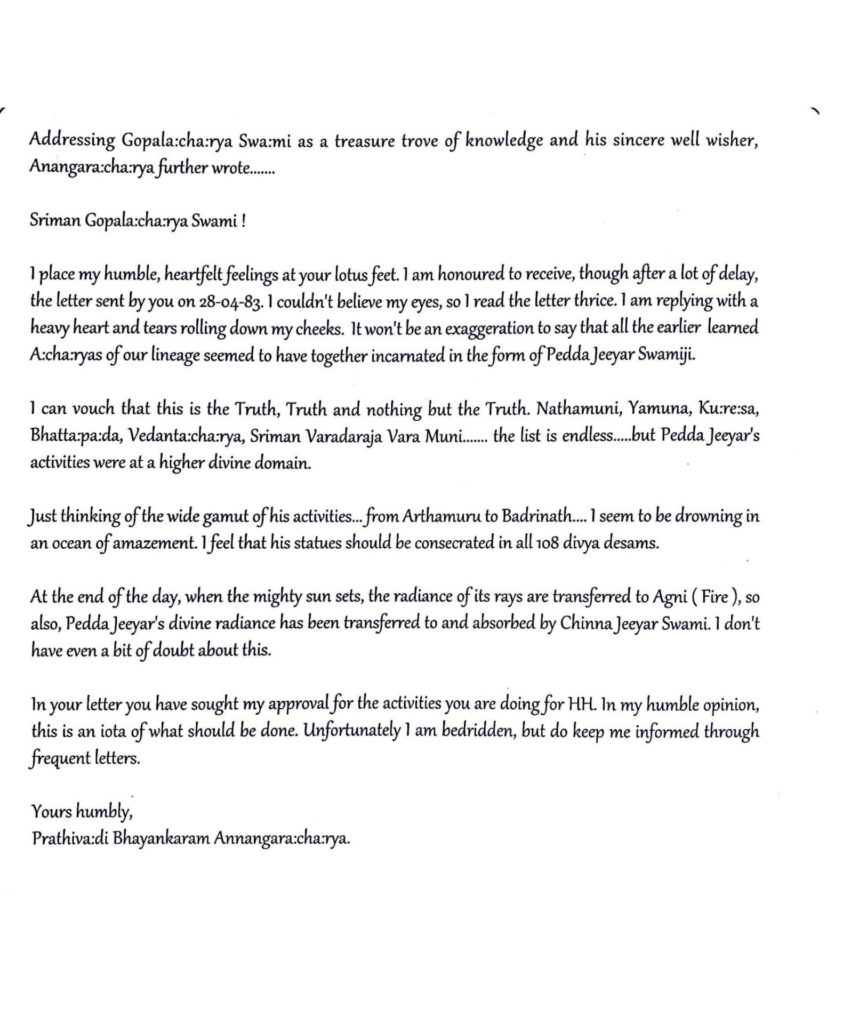
Replying to Sri Gopalacharya Swa:mi in 1983, the revered scholar Prathivadi Bhayankaram Annangaracharya wrote of Sri Pedda Jeeyar Swa:mi:ji with tears rolling down his cheeks:
“It won't be an exaggeration to say that all the earlier learned Acharyas of our lineage seemed to have together incarnated in the form of Pedda Jeeyar Swamiji… Just thinking of the wide gamut of his activities — from Arthamuru to Badrinath — I seem to be drowning in an ocean of amazement.”
“When the mighty sun sets, the radiance of its rays is transferred to Agni — so also, Pedda Jeeyar's divine radiance has been transferred to and absorbed by Chinna Jeeyar Swami.”
The Legacy Continues
In 1975, a young seeker from Arthamuru — the very village where Swamiji had built India's first Harijan colony — met him and found his life's direction. That seeker took Tridandi Sanya:sa as HH Sri Chinna Jeeyar Swa:mi:ji, completed his guru's vowed yajnas with the 1,008-kunda Maha: Yajna at Tirumala in February 1980, and in 1981 formed the Jeeyar Educational Trust with Sri Pedda Jeeyar Swa:mi:ji as its inspirer.
The 216-foot Statue of Equality at Divya Sa:ke:tham — raised by his successor for Bhagavad Ra:ma:nuja's millennium — stands on the path of samathwam he walked decades before it became a monument; at his 108th Thirunakshathram, devotees prayed to him for its completion. After Manavalamamuni, in the Ve:dic lineage of Bhagavad Ra:ma:nuja, it is Sri Pedda Jeeyar Swa:mi:ji who carried the divine message to every corner of the country.
Sources: chinnajeeyar.org · Bhakthi Nive:dana archives · JIVA publications