Skip to content

The Record · November 13–17, 2026

The Divine Manifestation of Sri: Sanjeevani Hanuma:n

Over five days at Sanjeevani Jeeyar A:sramam, in the presence of HH Sri: Tridandi Chinna Jeeyar Swa:mi:ji, the mu:rthi of Sri: Hanuma:n passed through every stage the Pa:nchara:thra A:gama lays down for a temple image — from the sprouting of seeds to the opening of the eyes — and was consecrated at the 9:30 AM muhu:rtham on Monday, November 16. This is the record of those days: what was done, in what order, and the texts that prescribe it.

The Pra:na Prathishtta — His Holiness at the mu:rthi of Sri: Sanjeevani Hanuma:n

Performed as the A:gama prescribes

The Pa:nchara:thra A:gama is the body of Vaishnava scripture that governs temple worship in the lineage of Sri: Ra:ma:nuja. Its samhita:s — Padma, Sa:thvatha, Pa:ushkara, Jaya:khya, I:svara, Sri:prasna, Purusho:ttama, Aniruddha and others — set down, step by step, how a mu:rthi is prepared, how life is invoked into it, and how it is worshipped thereafter.

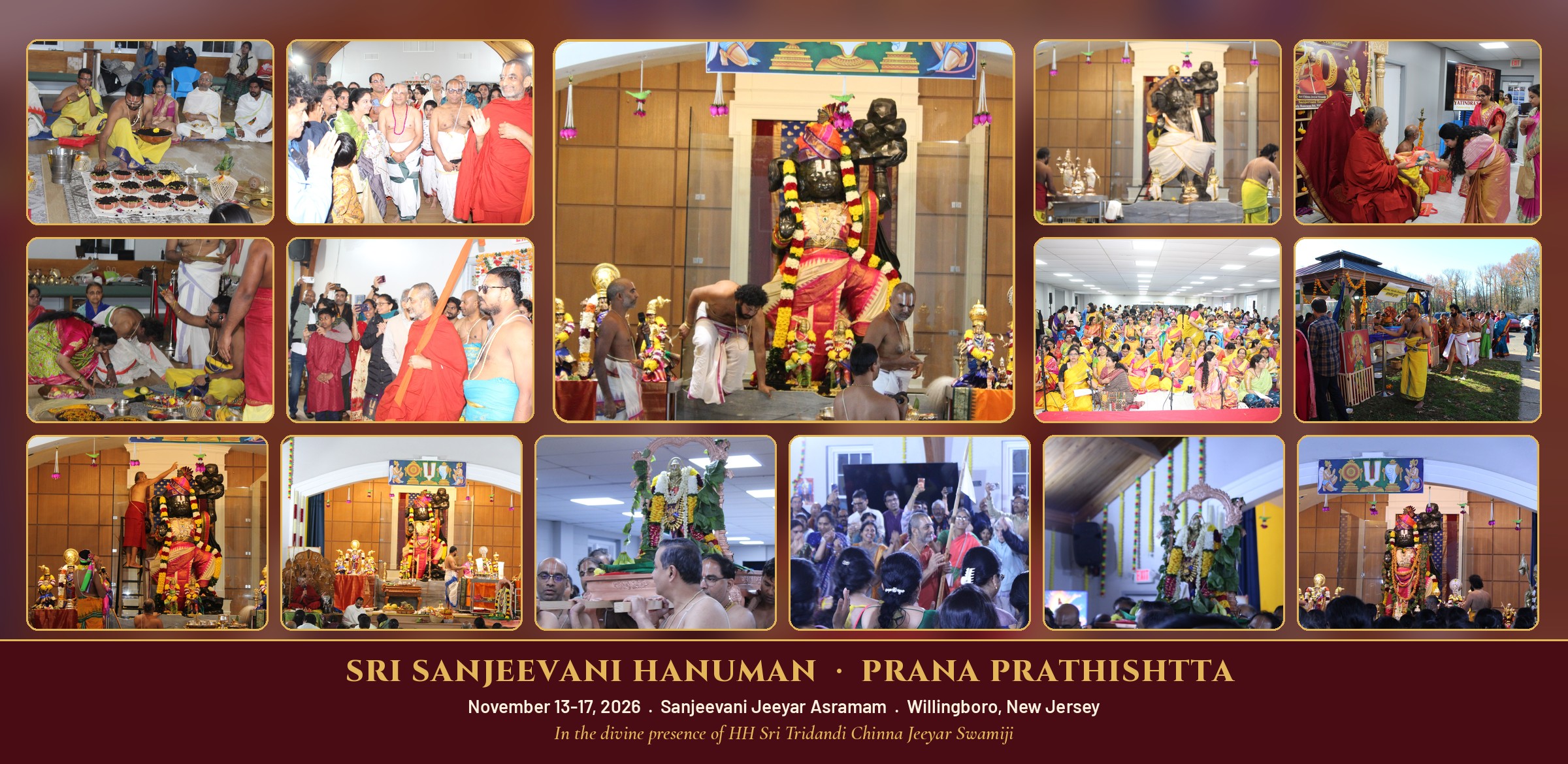
Collage of the five days of the Sri: Sanjeevani Hanuma:n Pra:na Prathishtta

Five days in one frame — download the collage and the deck below to share.

Day 1 · Friday, November 13

The Opening · Vishvakse:na Pu:ja & Ankura:rpanam

The rites begin at dusk: the ground is sanctified, the a:cha:ryas and the mu:rthi are bound with protective cords, and seeds are sown that will sprout through the week.

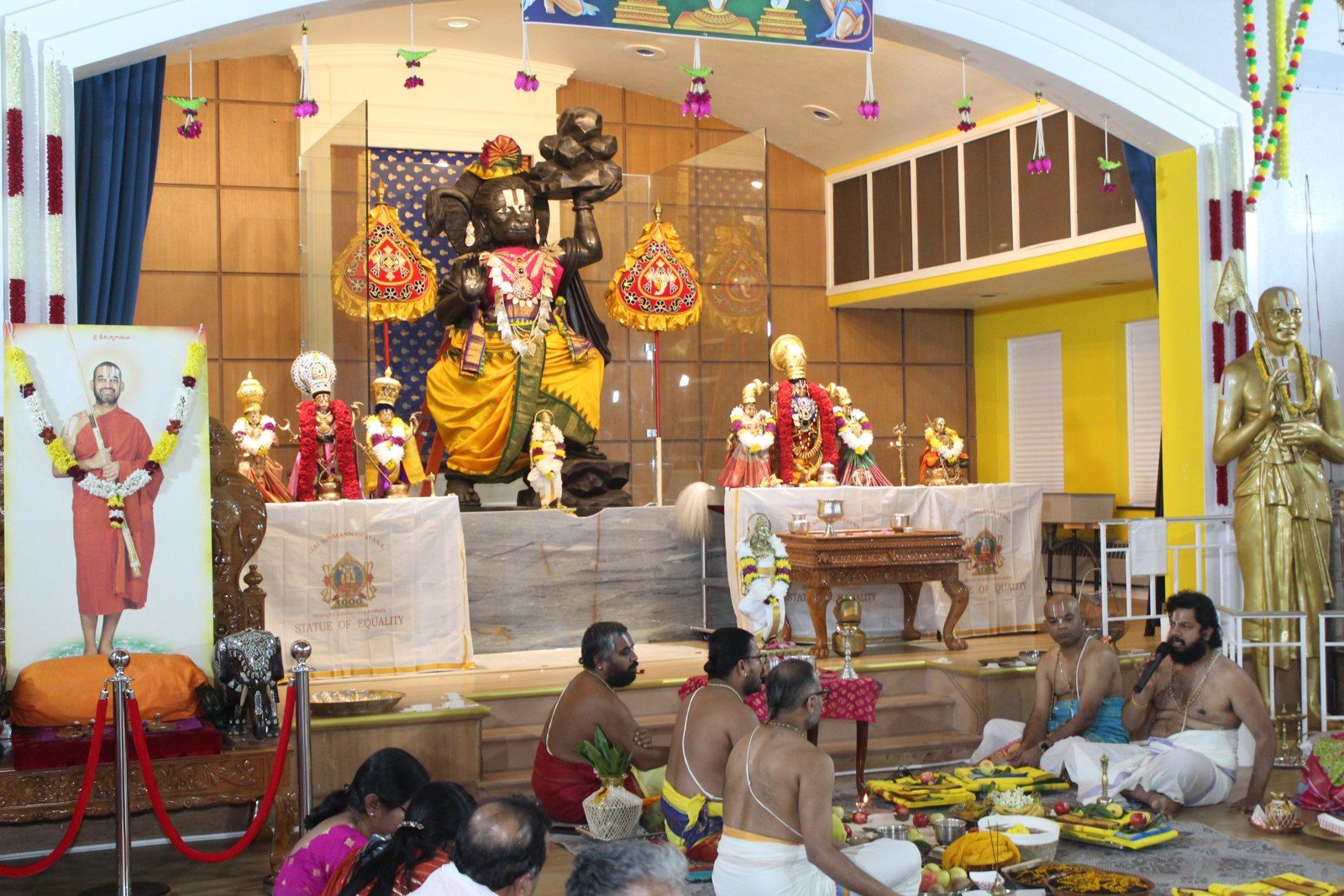
The hall on the opening evening, Friday November 13

Invoking the commander · sanctifying the ground

Vishvakse:na Pu:ja & Punya:hava:chanam

Every Pa:nchara:thra rite opens by honouring Vishvakse:na, the commander of Sri:man Na:ra:yana's hosts, who removes obstacles before the work begins. The punya:hava:chanam followed — the chanting of auspicious Vedic verses over water that was then sprinkled on the hall, the materials and everyone present, so that the whole five-day field of action began clean.

In the A:gama · 2 texts
  • Purusho:ttama Samhita: · Chapter 12
    Vishvakse:na-pu:ja is performed first, before the earth is gathered for the sprouting rites.
  • Aniruddha Samhita: · Chapter 33
    Vishvakse:na is honoured as the parivaara deity who guards every Vishnu temple's rites.

The protective cord

Raksha: Bandhanam

The a:cha:ryas tied raksha: (kankana) cords on their own wrists and on the mu:rthi — a vow that binds the priests, the sponsors and the image together for the duration of the rites, and a shield against interruption. Devotees received kankanams from the priests the next morning and joined the sankalpam.

In the A:gama · 1 text
  • Sri:prasna Samhita: · Chapter 23, verses 1–79
    The ritual of tying cords: the a:cha:rya ties the raksha:bandha on his own wrist and on the icon's.

Gathering earth · sowing the seeds

Mrith-samgrahanam & Ankura:rpanam

Earth was ceremonially gathered and laid in pa:lika: trays on a mandala, ringed by water-pots, and nine kinds of grain were sown in them by night — the moon being lord of plants. Their sprouting over the following days is read as the first sign that the land and the moment accept the deity. No Pa:nchara:thra consecration or festival begins without it.

In the A:gama · 4 texts
  • Purusho:ttama Samhita: · Chapter 12 (mrith-samgrahana) · Chapter 13, verses 26–43 (ankura:rpana)
    Earth is gathered after Vishvakse:na-pu:ja; pa:lika: trays are set on a mandala with water-pots around and the seeds planted.
  • Aniruddha Samhita: · Chapter 13, verses 7–33
    The germination ceremony as part of pratishtta, with the duties of patron and a:cha:rya step by step.
  • Ma:rkande:ya Samhita: · Chapter 13, verses 1–13
    Ankura:rpana is done on the ninth, seventh or fifth day before a consecration or festival.
  • Kapinjala Samhita: · Chapter 21
    The three kinds of germination vessels and how they are arranged.

Day 2 · Saturday, November 14

The Fire · Agni Prathishtta & Jala:dhiva:sam

The ya:gasa:la comes alive — fire is churned from wood, the ho:mas begin, His Holiness arrives to ko:la:tam, the community kitchen opens, and at night the mu:rthi rests in water.

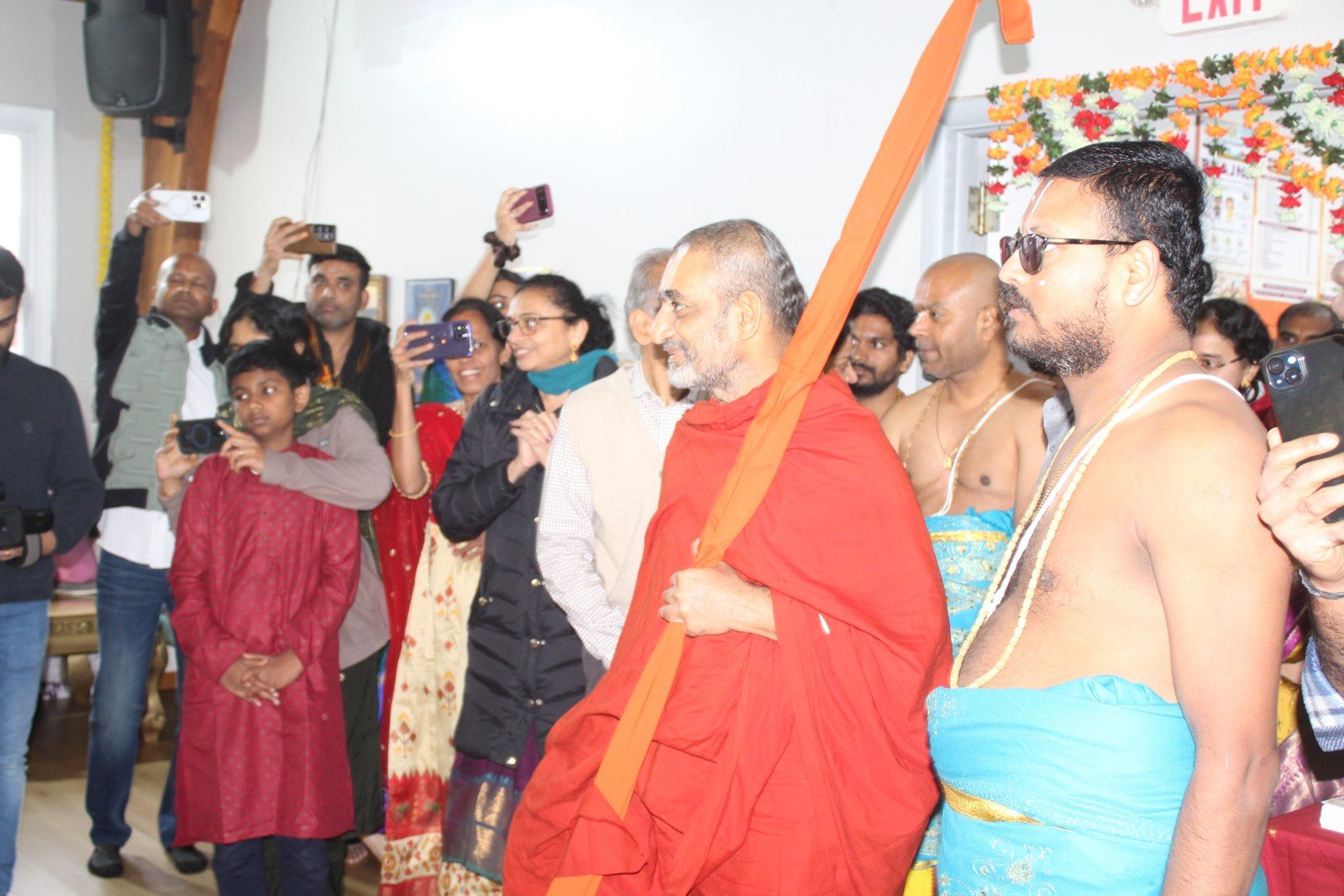
HH Swa:mi:ji welcomed with ko:la:tam on Saturday morning

Kindling the sacred fire

Ya:gasa:la Ho:ma:rambham & Agni Prathishtta

At 9 AM the fire was not struck but churned — arani mathanam, the friction of two pieces of sacred wood — so that Agni was born fresh for this rite alone. He was installed in the ho:ma kundas of the ya:gasa:la, and from this hour until Monday morning the oblations never ceased: chathustha:na archana at the four stations, special ho:mas, and the nithya pu:rna:huthi that closed each session.

In the A:gama · 2 texts
  • Padma Samhita: (Kriya:pa:da) · Chapters 26–28
    The ho:mas of the ya:gasa:la run from the adhiva:sa rites through the installation itself.
  • Bha:radva:ja Samhita: · Chapter 5
    After the grain-bed rite: night vigil, sa:nthi ho:ma, pu:rna:huthi and ho:ma at the Garuda kunda.

The A:cha:rya arrives · the kitchen opens

HH Swa:mi:ji's Arrival · Sathvik Bhog Opens · Vasantham

His Holiness was received around 11 AM with ko:la:tam and garba by hundreds of devotees. At noon, in his presence, the Sanjeevani Sathvik Bhog community kitchen served its first free meal — the seva that will outlast the festival. In the evening VT SEVA's annual Vasantham brought the youth wing's year of service to the stage.

Repose in water

Jala:dhiva:sam

After the evening ho:mas, the mu:rthi was laid to rest in water — head to the east, face to the north — with the chakra and raksha: mudra:s shown over it and Vedic chanting around it. The A:gama prescribes this immersion for stone, wood and metal images alike: it cools the stone of the sculptor's labour and begins the sequence of adhiva:sas, the 'dwellings', through which the image is made ready to receive life. Devotees offered thi:rtham to all the mu:rthis.

In the A:gama · 4 texts
  • Padma Samhita: (Kriya:pa:da) · Chapter 26 — jala:dhiva:sa-vidhi, verses 41–83
    The icon rests in water one to three nights, head east and face north, with chakra and raksha: mudra:s and Vedic recitation; prescribed for wood, stone and metal images.
  • Aniruddha Samhita: · Chapter 14, verses 1–17
    Immersion of the icon in vessels of water as the first of the consecration baths.
  • I:svara Samhita: · Chapter 18 — pratishtta:-vidha:na
    Jala:dhiva:sa within the installation procedure followed at Me:lko:te.
  • Sri:prasna Samhita: · Chapter 24
    The water-repose rite before installation.

Day 3 · Sunday, November 15

The Seventieth · Mruthika Snapanam & the Adhiva:sas

His Holiness's 70th Thirunakshathram: the mu:rthis are bathed in sacred earth, 1,008 food kits go out to Willingboro families, the goshti sings Gala:rchana, and at night the mu:rthi rests on grain and then on a bed of flowers and fruit.

His Holiness with the goshti on his 70th Thirunakshathram

The bath of sacred earth

Mruthika Snapanam

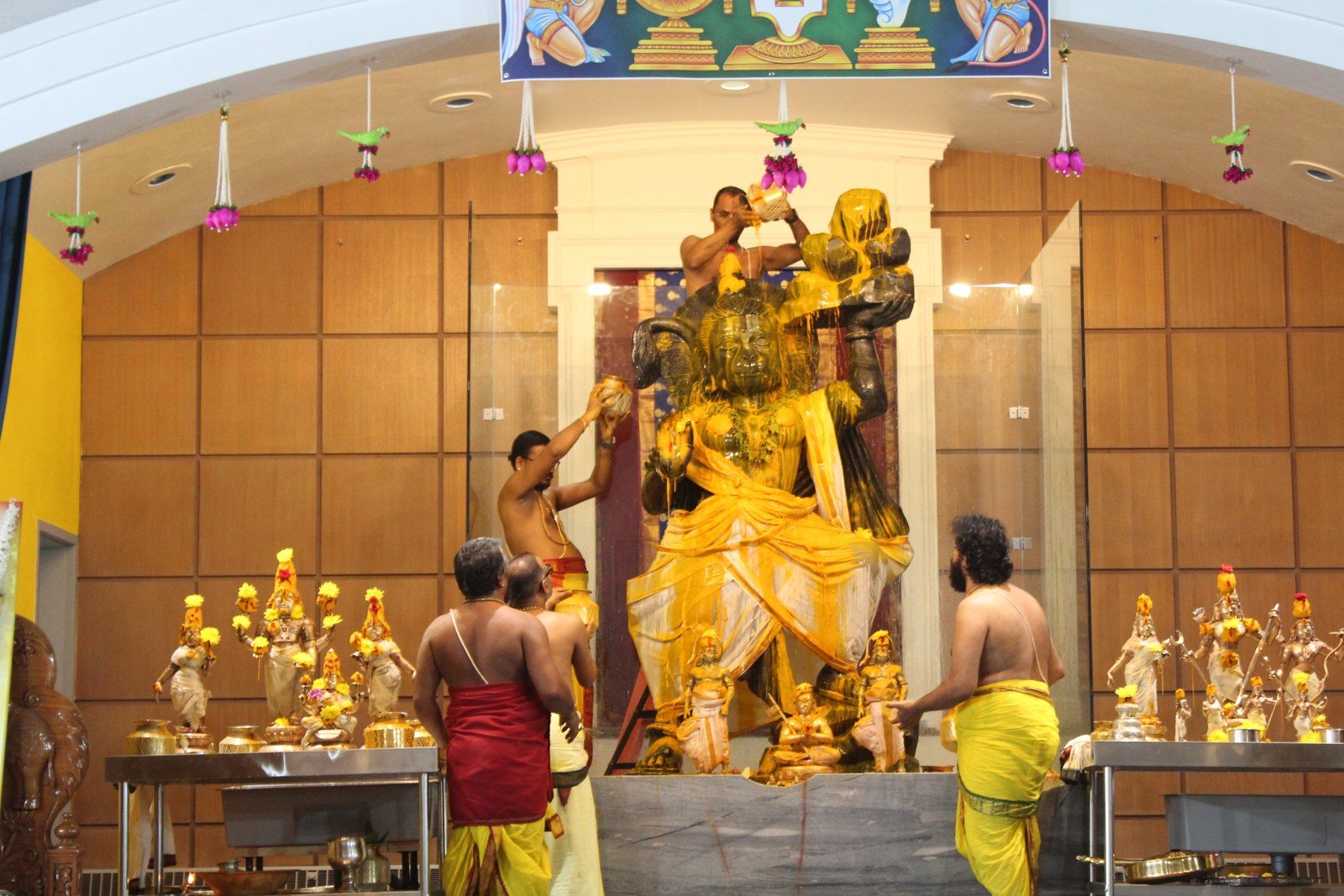
At 10 AM every mu:rthi received abhishe:kam, beginning with mruthika — earth gathered from sacred places — and then water and the other prescribed substances, before the devotees' eyes. The snapana purifies the image of whatever it carried from quarry and workshop, and it is the first time the goshti sees the Lord bathed.

In the A:gama · 3 texts
  • Aniruddha Samhita: · Chapter 14, verses 24–50
    Baths in mud, water, sandal-paste and the other substances in sequence, before the icon is laid to rest.
  • I:svara Samhita: · Chapter 15, verses 28–343
    The para (ten-fold) and apara (nine-fold) snapana rites.
  • Pa:rame:svara Samhita: (Kriya:ka:nda) · Chapter 14
    Snapana-vidha:na: the pot-counts of the greater and lesser baths, with at least four a:cha:ryas.

The 70th appearance day

A:cha:rya Thirunakshathram · 1,008 Food Kits · Gala:rchana

Sunday was HH Swa:mi:ji's 70th Thirunakshathram. At 2 PM, 1,008 food kits were handed to Willingboro-area families as the Maha: nive:dana. From 3 PM the goshti sang Ra:mada:su's Navarathna:lu together, organisations and temples offered marya:da:s, His Holiness gave his anugraha bha:shanam, and the day closed with A:cha:rya Sri: Pa:da Pu:ja and seventy offerings from the community.

Repose on grain

Dha:nya:dhiva:sam

In the evening the mu:rthi was lifted from water and laid on a bed of grain while its pi:tha was readied — the second dwelling. Grain is abundance; the Lord rests in it as a king rests in his storehouse before taking his seat.

In the A:gama · 2 texts
  • Padma Samhita: (Kriya:pa:da) · Chapter 26, up to verse 59
    The icon is placed on grains while the pedestal is made ready, then fixed to the pedestal and taken in procession.
  • Bha:radva:ja Samhita: · Chapter 5
    The Lord is laid on a bed of grains; a night vigil and sa:nthi ho:ma follow.

The night on a bed of flowers and fruit

Phala-Pushpa Sayya:dhiva:sam

Last of the dwellings: a couch was built in the mandapa and the mu:rthi, with the parivaara, was laid to sleep on fruit and flowers through the night before the prathishtta. The texts call it sayya:dhiva:sa — repose on the bed — the deity's last night as an image before awakening as the Lord.

In the A:gama · 2 texts
  • Purusho:ttama Samhita: · Chapter 19, verses 1–12
    Sayya:dhiva:sa: building the couch and laying the icon and its retinue upon it during the consecration rites.
  • Sanathkuma:ra Samhita: (Brahmara:thra) · Chapter 6, verses 1–8
    A sixteen-pillared mandapa is raised for the icon's sayana before consecration.
Day 4 · Monday, November 16

Pra:na Prathishtta · 9:30 AM

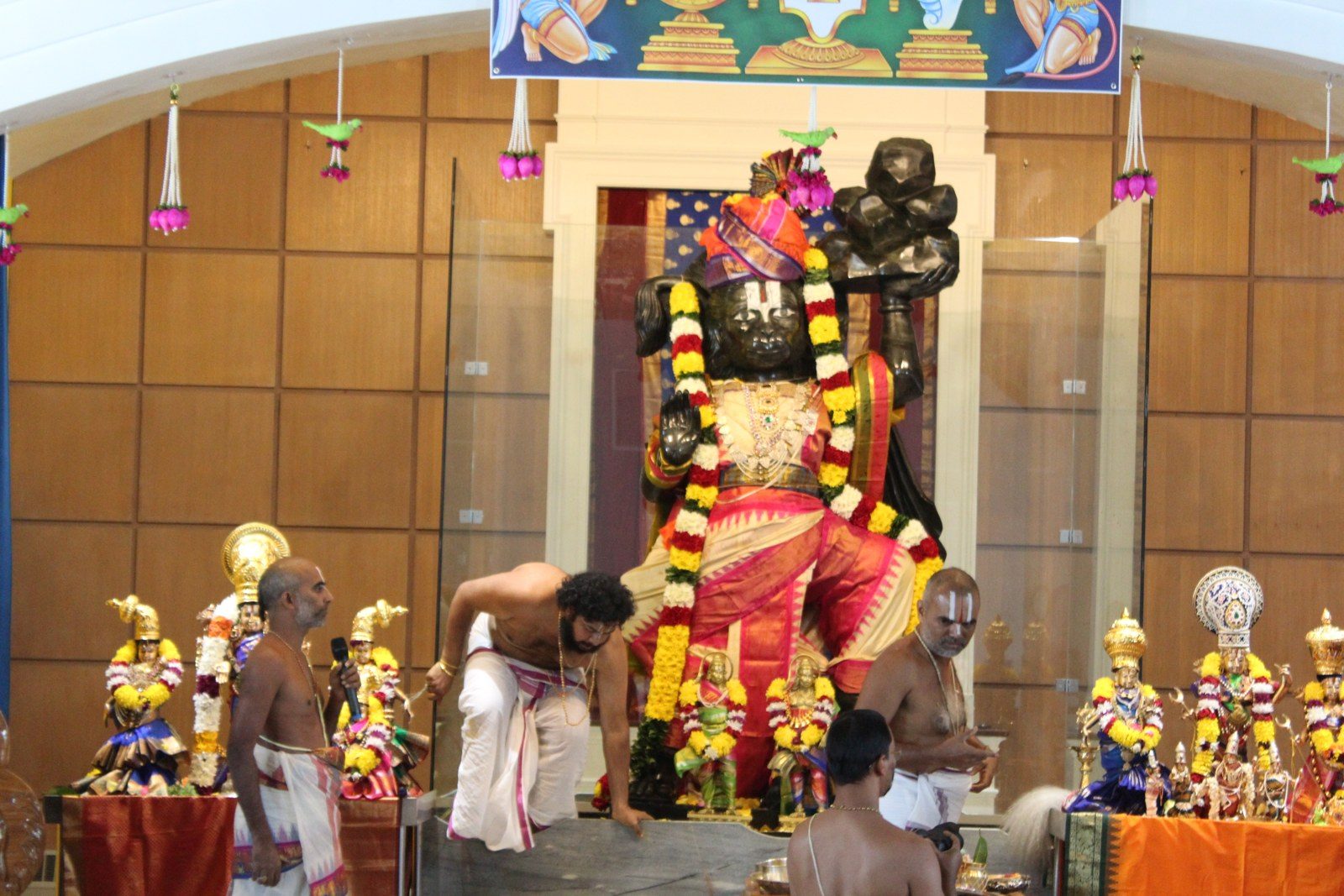
The fire rites conclude with the Maha: pu:rna:huthi, the sanctified kalasas are carried to the sanctum, and at the muhu:rtham HH Jeeyar Swa:mi:ji invokes life into Sri: Sanjeevani Hanuma:n. Kalya:nams follow, morning and evening.

The Pra:na Prathishtta — His Holiness at the mu:rthi of Sri: Sanjeevani Hanuma:n

The full oblation · lifting the kalasas

Maha: Pu:rna:huthi & Kalasa Udva:sanam

From 7 AM the ya:gasa:la's three days of ho:ma were gathered into the Maha: pu:rna:huthi — the full oblation that completes the fire. The 108 kalasas, whose waters had been charged by every manthra chanted into them since Saturday, were then lifted (udva:sana) and carried in procession from the ya:gasa:la to the sanctum.

In the A:gama · 2 texts
  • Padma Samhita: (Kriya:pa:da) · Chapter 28 — pratishtta:-vidhi
    The installation chapter: the kalasa waters and the fire's completion precede the invocation.
  • Bha:radva:ja Samhita: · Chapter 5
    Sa:nthi ho:ma and pu:rna:huthi close the adhiva:sa vigil.

Opening the eyes · invoking life

Ne:tho:nmi:lanam · Maha: Pra:na Prathishtta · Kumbha Pro:kshanam

At the 9:30 AM muhu:rtham His Holiness opened the eyes of Sri: Hanuma:n — ne:tho:nmi:lana, the rite the A:gama places at the threshold between image and deity — and performed the pra:na prathishtta, placing the vital breath into the mu:rthi through nya:sa and manthra, so that the stone became the dwelling of the Lord. The waters of the kalasas were then poured and sprinkled — kumbha pro:kshana — over the mu:rthi, the sanctum and every devotee present. From this moment Sri: Sanjeevani Hanuma:n is worshipped not as an image but as Hanuma:n himself.

In the A:gama · 8 texts
  • Padma Samhita: (Kriya:pa:da) · Chapter 28 — pratishtta:-vidhi
    The rites of installation.
  • Pa:ushkara Samhita: · Chapter 43, verses 71–118
    The consecration of images; the vital power is infused into the icon (verses 76–77).
  • Jaya:khya Samhita: · Chapter 20
    Pratishtta:-vidha:na — the sanctification ceremonies of the image.
  • Kapinjala Samhita: · Chapter 12, verses 1–192
    The sixteen steps of pratishtta, from the mandapa to the icon fixed on its pedestal.
  • Agasthya Samhita: · Chapter 5, verses 18–64 · Chapter 13
    Ne:tho:nmi:lana — opening the icon's eyes — among the bathing rites; pro:kshana as the first of the five purifications.
  • Aniruddha Samhita: · Chapter 14, verses 18–23
    The eye-opening between the water-repose and the baths.
  • Visva:mithra Samhita: · Chapter 14, verses 63–88
    Sprinklings through the whole temple after the icon is installed.
  • Lakshmi: Tanthra · Chapter 49 — pratishtta:-vidha:na
    The installation procedure in the Pa:nchara:thra's Lakshmi: Tanthra.

The first worship · the peace-weddings

Prathama A:ra:dhana & Sa:nthi Kalya:nam

The first a:ra:dhana — the daily worship that will now continue every day at Sanjeevani — was offered immediately, with nive:dana and thi:rtha prasa:da goshti. Then the sa:nthi kalya:nams: Sri:niva:sa Kalya:nam and Si:tha-Ra:ma Kalya:nam, the celestial weddings celebrated to bless the new sanctum and the community with peace. His Holiness gave his a:si:rva:chanam and the a:cha:ryas were felicitated.

In the A:gama · 3 texts
  • Na:radi:ya Samhita: · Chapter 2, verses 4–65
    A:ra:dhana-vidha:na — the daily routine of entering the temple, purification and worship.
  • Parama Samhita: · Chapter 21
    The first bathing rites after the Lord's establishment in the temple.
  • Purusho:ttama Samhita: · Chapter 15, verses 28–37
    Sa:nthi ho:ma before the palanquin procession of the festival.

The divine wedding

Sri: Si:tha-Ra:ma Kalya:nam

In the evening the grand Si:tha-Ra:ma Kalya:nam was celebrated before Hanuma:n — his Lord's wedding on his own first day — with every family offering akshata at the ma:ngalya dha:rana, and the day closed with Maha: prasa:d for all.

Day 5 · Tuesday, November 17

The Offering · Vadama:la & Concluding Mangalam

The first full day of worship: morning a:ra:dhana and Mahaprasa:dam, then the pallaki procession, the great vada garland, the betel-leaf archana and the Maha: Ha:rathi that closed the mahotsavam.

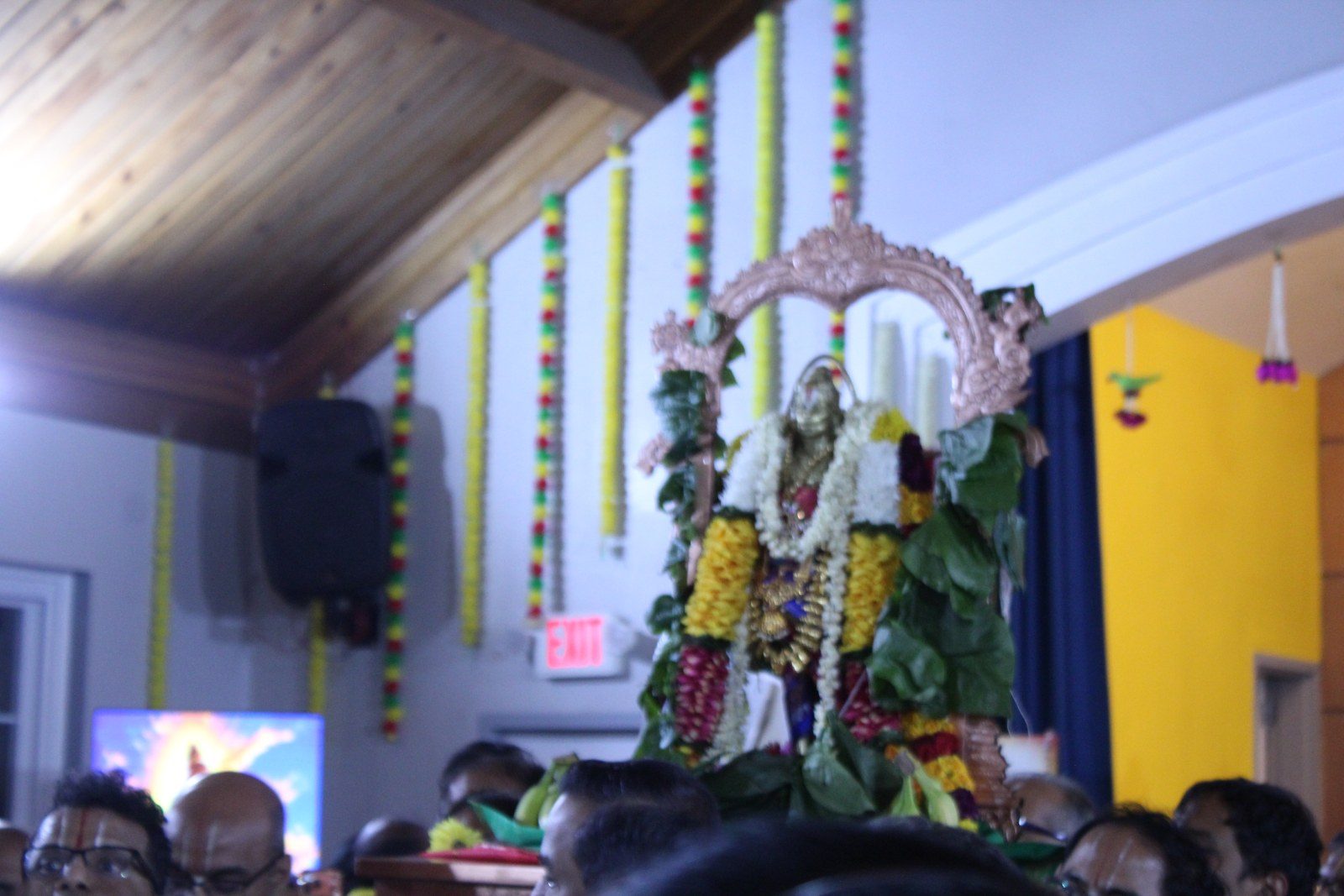
Sri: Sanjeevani Hanuma:n with the vadama:la on the closing night

The palanquin · the vada garland · the betel-leaf archana

Pallaki Se:va · Hanuma:n Vadama:la & Aakupu:ja Se:va

After an abhishe:kam of turmeric and sandal, the utsava mu:rthi was carried in pallaki by the devotees — the Lord's first procession through his own A:sramam. Then Hanuma:n was honoured with a garland of vadas, a tradition of his temples across the Deccan, and with archana of betel leaves, each leaf offered with a name. Families sponsored vadama:las, chanted the Cha:li:sa, and received blessed vadama:la boxes after the Maha: Ha:rathi.

The closing lamp

Maha: Ha:rathi & Concluding Mangalam

With the Maha: Ha:rathi, the goshti's mangalam and thi:rtha prasa:dam, five days of unbroken rites concluded. The volunteers of thirteen seva teams who carried them were honoured last. Daily a:ra:dhana to Sri: Sanjeevani Hanuma:n has continued every morning and evening since.

The Texts

The Pa:nchara:thra Samhita:s Cited

Chapter numbers follow the standard printed editions as catalogued in the Pa:nchara:thra indices. They show that every rite performed at Sanjeevani is prescribed by the A:gama; the detailed kalpa followed on each day was that of the officiating a:cha:ryas.

  • Padma Samhita: (Kriya:pa:da, chapters 26–28)

    Jala:dhiva:sa and dha:nya:dhiva:sa (ch. 26), pratishtta:-vidhi (ch. 28). The samhita: most followed in Sri: Vaishnava temples.

  • Pa:ushkara Samhita: (ch. 43)

    One of the three 'gems' of the Pa:nchara:thra; the infusion of vital power into the image.

  • Jaya:khya Samhita: (ch. 20)

    The second of the three gems; pratishtta:-vidha:na.

  • I:svara Samhita: (ch. 15, 18)

    Snapana and installation; the text of daily worship at Me:lko:te.

  • Sri:prasna Samhita: (ch. 23–24)

    Raksha:bandhana and jala:dhiva:sa.

  • Purusho:ttama Samhita: (ch. 12–13, 15, 19)

    Mrith-samgrahana, ankura:rpana, sa:nthi ho:ma, sayya:dhiva:sa.

  • Aniruddha Samhita: (ch. 13–14)

    Ankura:rpana; the immersion, eye-opening and bathing sequence.

  • Ma:rkande:ya Samhita: (ch. 13)

    The timing of ankura:rpana before a consecration.

  • Kapinjala Samhita: (ch. 12, 21)

    The sixteen steps of pratishtta; the germination vessels.

  • Agasthya Samhita: (ch. 5, 13)

    Ne:tho:nmi:lana; the five purifications beginning with pro:kshana.

  • Bha:radva:ja Samhita: (ch. 5)

    Dha:nya:dhiva:sa, vigil, sa:nthi ho:ma and pu:rna:huthi.

  • Na:radi:ya, Parama, Pa:rame:svara, Visva:mithra, Sanathkuma:ra Samhita:s · Lakshmi: Tanthra

    A:ra:dhana, snapana, post-installation pro:kshana, the sayana mandapa, pratishtta:-vidha:na.

Daily a:ra:dhana continues

Come for Darshan

Sri: Sanjeevani Hanuma:n is worshipped every morning and evening at Sanjeevani Jeeyar A:sramam, 494 Beverly Rancocas Rd, Willingboro. The program, the film and the ways to support the A:sramam are a click away.

Join our community