
Narayana Narayana Narayana
The Unifying Supreme: Narayana in Vedanta Vedic Unity The Acharyas Convergence Data Scriptural Evidence Unification Factors The Acharyas Convergence Data Scriptural Evidence Unification Factors Unity in Vedanta One Supreme Destination: Narayana Despite philosophical differences in the relationship between the Soul and God, Adi Sankaracharya, Ramanujacharya, and Madhvacharya unanimously identify Narayana (Vishnu/Krishna) as the Supreme Cause and Controller of the Universe. See Common Factors Explore Evidence The Verdict of the Acharyas Select an Acharya to see their specific proclamation regarding the Supremacy of Vishnu/Narayana. S Adi Sankaracharya Focus: Advaita (Non-Dualism) Though emphasizing the formless Brahman, Sankara explicitly identifies Narayana as the Supreme Lord (Ishwara) controlling the Maya. R Ramanujacharya Focus: Vishishtadvaita Propounded that Sriman Narayana is the Supreme Soul (Paramatman) who holds all souls and matter as His body. M Madhvacharya Focus: Dvaita (Dualism) Asserted Hari (Vishnu) as the only Independent Reality (Svatantra) and the supreme controller of all existence. The Theological Convergence We mapped the commentaries of the three Acharyas against five key theological attributes of the Supreme Being. Notice the almost perfect overlap (Unity) in identifying Vishnu/Narayana as the filler of these roles. Key Insights from Analysis Universal Creator (Jagat Karana) All three agree that the “Brahman” defined in the Sutras as the Creator is Narayana. The Object of Worship (Upasya) Whether as a step to liberation (Sankara) or the end itself (Ramanuja/Madhva), Vishnu is the object of devotion. Identity of Krishna Unanimous agreement that Krishna is the Purna-Avatara of Narayana and the Supreme Person of the Gita. “Though the paths of logic differ, the destination of the heart remains One.” The Evidence: In Their Own Words Filter the research by Scripture or Acharya to find the common thread. All Bhagavad Gita Upanishads Brahma Sutras Treatises 5 Factors for Unification Common grounds to unite all devotees in India, irrespective of Sampradaya. The Supreme Name All agree the supreme name “Narayana” or “Vishnu” applies to the Ultimate Reality (Saguna Brahman). The Source Text All three rely on the Bhagavad Gita and Vishnu Sahasranama as authoritative texts for Moksha. Krishna Tattva Unanimous acceptance of Krishna as the Supreme Lord manifest, not a demigod. Bhakti is Essential Even for Sankara, Bhakti to Govinda is the essential purifier required before Jnana. Beyond the Unmanifest All agree the Lord is superior to the unmanifest matter (Avyakta). “Narayana paro avyaktat” – The Unifying Mantra found in Gita Bhashya Intro Synthesized research based on standard commentaries of the Acharyas.
Exhaustive Exegesis of Tiruppavai Pasuram 7
A Visishtadvaita Catechism on the Esoteric and Exoteric Significance of ‘Keesu Keesu I. Preamble: The Dawn of the Seventh Day 1.1 The Contextual Landscape of Margazhi The Tiruppavai, composed by the divine poetess Andal (Godadevi), is not merely a collection of devotional hymns; it is the seed of the Vedas (Vedam Anaithukkum Vithagum).1 In the Visishtadvaita tradition, specifically within the lineage of Sri Ramanuja (acknowledged as the Tiruppavai Jeeyar), every stanza is viewed as a condensed capsule of the Rahasya Traya—the three supreme secrets of Vaishnavism: the Tirumantra, the Dvaya, and the Charama Sloka.2 The seventh Pasuram, “Keesu Keesu Endru,” represents a critical threshold in the spiritual progression of the Pavai Nonbu (the vow of Margazhi). Having addressed the initial aspirants in the earlier verses, Andal now arrives at the doorstep of a more advanced adhikari (qualified soul). This Pasuram is situated in the early hours of Brahma Muhurtham, a time sanctified for spiritual awakening. The sensory environment described—the cacophony of birds, the rhythmic churning of yogurt, the jingling of ornaments—is not merely poetic atmosphere but a rigorous theological architecture designed to awaken the soul from the slumber of Samsara (material existence) to the wakefulness of Kainkaryam (divine service). 1.2 The Identity of the Sleeper In the esoteric commentary (Swapadesam), the identity of the sleeping maiden in this verse is a subject of profound contemplation. While the surface narrative (Anyapadesam) depicts a Gopi of Gokulam, the inner meaning points to a great Acharya or Azhwar. Kulasekhara Azhwar: The address Nayaka Penpillai (Leader of the girls) and Thesamudaiyay (One with a kingdom/radiance) strongly suggests Kulasekhara Azhwar, the royal saint who neglected his kingly duties for the sake of Bhagavat Anubhavam (experience of God).3 Pey Azhwar: The term Pey Penne (Deluded/Demon girl) directly links to Pey Azhwar, one of the first three Azhwars, who was so intoxicated by divine love that the world deemed him mad (Pey).5 This report, formulated as an exhaustive catechism, explores the duality of these meanings, analyzing the verse syllable by syllable to extract the Visishtadvaita essence. II. The Auditory Awakening: Analysis of the First Paadha (Lines 1-2) A . The Phonetics of Awakening What is the philological and theological significance of the opening phrase “Keesu Keesu Endru”? The Literal Meaning (Padartha): “Keesu Keesu” is an onomatopoeic duplication representing the chirping sound of birds at dawn.6 In the Tamil linguistic tradition, such reduplicated words signify intensity, continuity, and plurality. It is not a single chirp but a chorus. The word Endru implies “thus” or “saying so,” suggesting that the birds are not just making noise but communicating a specific message. The Esoteric Meaning (Swapadesam): In the Acharya Para interpretation, the “birds” represent the Acharyas (spiritual preceptors) and the “Keesu Keesu” sound represents the chanting of the Vedas and the Divya Prabandhams.5 The Inarticulate Sweetness (Avyakta Madhura): To the uninitiated ear, the chanting of Vedic mantras might sound like an indistinct “Keesu Keesu.” However, for the wise, it is avyakta madhura—sweet even when the specific semantic meaning is not immediately grasped by the listener. It signifies the Sabda Brahman (God as Sound) permeating the morning air. The Ubiquity of Grace: The sound serves as the first empirical evidence of grace. Just as the birds chirp without expectation of reward, the Acharyas disseminate knowledge out of pure compassion (Nirhetuka Kripa). Analyze the word “Engum” (Everywhere). Why does Andal emphasize spatial ubiquity? The Argument of Reality: Andal uses the word Engum to counter the potential skepticism of the sleeping girl. The sleeper might argue, “You say it is dawn, but perhaps that is only a bird chirping in your backyard. It is a localized disturbance, not a universal morning.” The Rebuttal: Andal asserts Engum—everywhere. The sound is omnipresent. It is in the east, west, north, and south. This signifies that the awakening is not a hallucination of the Gopis outside but an objective reality.5 Theological Implication: This points to the omnipresence (Vybhutva) of the Lord and the universal applicability of the Vedic truth. The message of the Acharyas is not confined to a single Matham (monastery) or Desam (country); it is Engum—permeating all directions. It suggests that the time for spiritual endeavor is universal; no place is exempt from the call of the Divine. The Literal Meaning (Padartha): “Keesu Keesu” is an onomatopoeic duplication representing the chirping sound of birds at dawn.6 In the Tamil linguistic tradition, such reduplicated words signify intensity, continuity, and plurality. It is not a single chirp but a chorus. The word Endru implies “thus” or “saying so,” suggesting that the birds are not just making noise but communicating a specific message. The Esoteric Meaning (Swapadesam): In the Acharya Para interpretation, the “birds” represent the Acharyas (spiritual preceptors) and the “Keesu Keesu” sound represents the chanting of the Vedas and the Divya Prabandhams.5 The Inarticulate Sweetness (Avyakta Madhura): To the uninitiated ear, the chanting of Vedic mantras might sound like an indistinct “Keesu Keesu.” However, for the wise, it is avyakta madhura—sweet even when the specific semantic meaning is not immediately grasped by the listener. It signifies the Sabda Brahman (God as Sound) permeating the morning air. The Ubiquity of Grace: The sound serves as the first empirical evidence of grace. Just as the birds chirp without expectation of reward, the Acharyas disseminate knowledge out of pure compassion (Nirhetuka Kripa). The Argument of Reality: Andal uses the word Engum to counter the potential skepticism of the sleeping girl. The sleeper might argue, “You say it is dawn, but perhaps that is only a bird chirping in your backyard. It is a localized disturbance, not a universal morning.” The Rebuttal: Andal asserts Engum—everywhere. The sound is omnipresent. It is in the east, west, north, and south. This signifies that the awakening is not a hallucination of the Gopis outside but an objective reality.5 Theological Implication: This points to the omnipresence (Vybhutva) of the Lord and the universal applicability of the Vedic truth. The message of the Acharyas is not confined to a single Matham (monastery) or Desam
SanJeevani Hanuman Deeksha
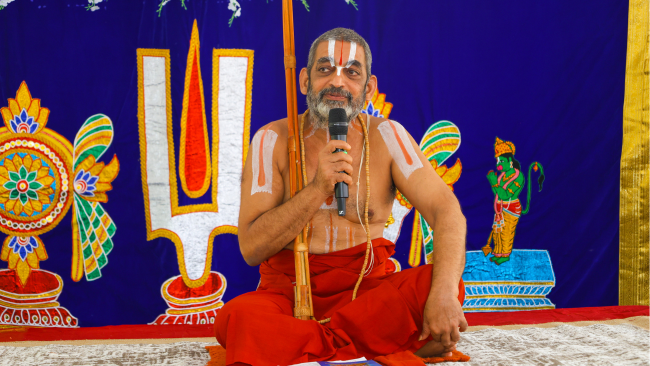
Oct 31, 2025 to Nov 3, 2025https://www.jetnj.org/wp-content/uploads/2025/12/IMG_7560.mp4https://www.jetnj.org/wp-content/uploads/2025/12/IMG_7920.mp4https://www.jetnj.org/wp-content/uploads/2025/12/IMG_7561.mp4 Click here for more photos